Chambers to corridors
Some caverns hold towns, herds, and agriculture. Others are barely wide enough to pass through black stone.
 The Deep RangeThe Deep Range
A world beneath the ice
A subterranean Western of glowing pasture, geothermal rivers, dinosaur mounts, and the people who built civilization in the warm dark.
Scroll into the warm dark
The shape of the world
The surface is locked in a permanent ice age. Human civilization survives below it in a continental network of immense caverns, geothermal basins, underground rivers, crystal forests, and deep passages where life found another way to thrive.
Rangers cross glowing fungal pasture on Utahraptor mounts, dire wolves work livestock through the dark, and settlements gather wherever warm stone, moving water, and productive range make permanent life possible.
World Lore
Start with the foundation, then follow the systems that keep a sunless civilization alive.
The permanent ice age, the underground civilization, and the logic holding the setting together.
02Caverns, basins, rivers, deep zones, crystal forests, and the routes between them.
03The Mineral Web, living pasture, bioluminescence, and life without sunlight.
04Mount work, herd drives, scouting, grazing rights, and reading water and stone.
05Fungal staples, livestock, greenhouses, preservation, and surviving without sun.
06Water access, power, homes, workshops, stock facilities, roads, and trade hubs.
07Water power, electricity, pumps, repair, salvage, communications, and fabrication.
08Rangers, outfits, professions, customs, economy, status, and ordinary life.
09Floods, toxic vents, predators, raiders, geological failure, and the frozen surface.
10A quick field guide to the terms that make the Deep Range make sense.
World Lore · Foundation
The essential shape of the Deep Range, the frozen world above it, and the narrow living country humanity built between fatal cold and rising heat.
First, forget the single-cave idea
It is an enormous interconnected subterranean realm, not one cavern, one settlement, or one neat little underground neighborhood.
Its caverns, lava tubes, rivers, basins, shafts, and deep passages stretch across enormous distances beneath the frozen surface.
Humanity survives here because the Up-World no longer supports ordinary life. Everything dependable is built around the conditions underground.
Where the living Range can support people, communities endure. Beyond that worked and understood country, every journey becomes survival.
Above the Range
The surface is locked in a deep, multi-millennial ice age. It is ancestral ground, but it is no longer ordinary human country.
Only a limited number of shafts, lava tubes, glacial caves, and fractured passages still connect the two worlds. Most are sealed, guarded, difficult to reach, or deliberately avoided.
Humanity lives between extremes
Temperature rises with depth. The Deep Range’s livable country exists where underground water stays liquid, stone remains warm enough to support life, and conditions remain cool enough for people and livestock.
Conditions grow colder as tunnels approach the frozen surface.
Warmth and liquid water overlap here, creating the narrow band where civilization can endure.
Heat rises steadily until the depths become too hostile for ordinary human life.
Above, fatal cold. Below, rising heat. Between them, home.
The world humanity left behind
The Up-World is nearly unlivable, but it has never stopped mattering. Open each piece of the surface’s place in Deep Range culture.
The surface is where humanity came from, even if most people now know it through inherited memory.
Buried ruins and dead cities preserve the scale of what the ice age destroyed.
Metal, glass, machinery, seeds, and other remnants may still wait beneath the ice.
Reaching those remnants means entering cold country where ordinary life cannot last.
Stories still circulate about lost cities, forgotten systems, warm refugia, and surviving life above. Most remain unproven. That has never stopped people from looking.
Everything comes back to balance
Life in the Deep Range depends upon six things remaining dependable enough for people to stay.
When those things hold, communities can thrive. When one fails, people adapt. When several fail at once, they move.The Deep Range is livable not because humanity conquered it, but because generations learned how to work within systems far larger than themselves.
World Lore · Country Without a Horizon
The Deep Range is three-dimensional country. Routes bend, climb, drop, flood, collapse, and reconnect through a continental world where above and below matter as much as ahead.
The shape of the country
The Range expands, narrows, rises, drops, fractures, and reconnects. Surface-style straight lines are usually terrible liars down here.
Some caverns hold towns, herds, and agriculture. Others are barely wide enough to pass through black stone.
Knowing what lies above and below matters nearly as much as knowing what waits ahead.
Travel time depends on safe connections, not physical closeness or a clean line on a flat map.
The underground is never truly fixed. Water, pressure, collapse, erosion, ice, and geothermal activity keep rewriting the usable world.
Vertical country
These are useful environmental bands, not clean borders. Local geology loves breaking tidy categories for sport.
Ice, frozen runoff, cold drafts, sparse growth, abandoned passages, glacial caves, and buried ruins become more common as the living Range thins away.
Productive basins, working rivers, ranch country, trade corridors, stable springs, and most permanent communities occupy this livable middle band.
Intense geothermal activity, rare materials, unusual ecosystems, unstable ground, toxic gases, volcanic fractures, and boiling water limit lasting human use.
The country changes chamber by chamber
Open a field note for the basic geography of each environment. This is the tour, not the entire cave encyclopedia.
Large chambers or connected systems where warmth, water, stable stone, ventilation, and usable space overlap well enough to sustain life.
Biologically productive open country, broad or pocketed, linked by passages that people and working animals can actually use.
Dry galleries, ice-rimmed tunnels, mineral deserts, and dark chambers where weak warmth and scarce water leave almost no forage.
Long, relatively smooth natural corridors that often become roads, drive routes, and freight connections between distant basins.
Waterways that carve caverns, connect regions, create crossings, and turn their banks into natural travel corridors.
Enclosed waters large enough to divide nearby regions, support shore communities, and hide unmapped passages beneath them.
Warm, mineral-rich sites that can anchor useful country when their heat, chemistry, and flow remain dependable.
Towering mineral formations that create beautiful but difficult country full of narrow sightlines and unpredictable echoes.
Drops, ledges, waterfalls, ramps, bridges, hoists, and animal paths that decide which cavern levels can truly connect.
Traveling without a horizon
There is no sun, no stars, no distant mountain line, and no open horizon. A route is remembered as a sequence of places and conditions inside the stone.
Echoes can make movement seem closer, farther away, or in the wrong direction. Running water may hide other sounds entirely.
Temperature, moisture, smell, and airflow can reveal higher passages, geothermal activity, water, shafts, or large connected chambers.
Maps are guides, never absolute truth. Tunnels collapse, rivers shift, fractures open, and multiple elevations resist clean flat-page logic.
Reading the country: Warm rock, fungal growth, mineral stains, insects, animal unease, cold air, and distant water all make the landscape legible to an experienced traveler. The Range has no horizon. Its people learn to read much closer to the ground.
World Lore · Life Without Sunlight
Stone, water, heat, chemistry, microbes, fungi, animals, and people form one connected living system. Down here, geology is part of the food web.
The base of every living system
Chemosynthetic microorganisms draw energy from compounds released through vents, seeps, aquifers, fractures, and chemically rich groundwater. Larger life builds upward from them.
The rule beneath every rule: when geothermal chemistry changes, biology changes with it.
The foundation of life
Microbial communities spread through wet stone, sediment, waterways, porous rock, spring beds, and chemically rich mud. Where favorable conditions last, those foundations can support entire cavern ecosystems.
The Mineral Web is not one giant organism. It is the name Rangers use for the connected ecological systems created wherever chemistry, microbes, water, and larger life interact.
One clue is never enough
Experienced Rangers compare several conditions before deciding whether a region is genuinely productive.
Stable warmth, reliable moisture, clear or chemically steady water, consistent mineral deposits, and healthy microbial films.
Strong fungal growth, dense root systems, productive grazing organisms, and surfaces that show active regeneration.
Active insect populations and ordinary cave-animal behavior often reveal whether the lower levels of the system are functioning.
Normal livestock appetite and feeding behavior can confirm what stone, water, and small life are already suggesting.
A cavern can look lush while the systems beneath it are weakening. A bare-looking chamber may also be preparing for new growth. Ecology is rude like that. It refuses to be judged by one pretty surface clue.
Seasons without a sky
Productive country is never frozen in one perfect state. Water, chemistry, heat, grazing pressure, and time keep every basin moving through change.
A depleted chamber is not automatically dead. If its Mineral Web, water, roots, and geothermal support remain healthy, resting range can recover. Returning too early can reset the process.
Light is information
Many organisms produce light, but the glow is not decoration pasted onto the caves. Its normal patterns belong to the ecosystem, and changes can reveal that something in the Range has shifted.
Increased activity may accompany fresh growth and changing chemistry.
Brightening, dimming, or color changes can follow altered flow or thermal conditions.
Unusual light behavior may appear when organisms are disturbed or unhealthy.
A changed pattern can warn that nearby animals or physical events have disrupted familiar life.
Rangers learn the ordinary light language of familiar country. When that language changes, they pay attention.
World Lore · Working the Living Range
The practical knowledge used to move livestock, manage working animals, read underground country, and keep an outfit alive between settled basins.
More than riding
Good Rangers are animal handlers, scouts, environmental readers, and practical problem-solvers at the same time. The Range punishes anyone who understands only one part of the job.
People, livestock, working animals, freight, veterinary supplies, camp gear, trade goods, and established routes form one mobile working system.
A Ranger may handle mounts, move herds, judge forage, inspect water, scout tunnels, respond to predators, treat injuries, and choose safe ground.
The boss weighs route timing, herd condition, grazing pressure, water, animal fatigue, predator movement, and geological change before deciding when to move.
A poor decision can cost animals. A very poor decision can cost the outfit.
The primary riding animal
A Ranger does not sit on passive transportation. They work in partnership with a fast, intelligent predator trained for immediate movement through dangerous country.
High-cantled tack helps secure a rider through sharp turns and sudden acceleration, but it must still let the animal move naturally. Painful equipment makes a dangerous working partner less reliable, not more obedient.
Control is a conversation
Experienced riders combine several cues because cave noise can make any single signal unreliable.
Voice, neck or crest pressure, rider position, and familiar trained signals work together instead of competing for the animal’s attention.
Posture, movement, sound, and bioluminescence reveal calm work, alarm, aggression, caution, or stealth before a rider sees the cause.
Consistency, routine, reward, firm boundaries, and non-cruel correction create a mount willing to respond under pressure.
Utahraptors remain powerful predators. A rider who loses the animal’s trust or respect may be ignored, abandoned, or injured.
Steady mount, skilled rider. An animal’s working behavior reflects the person handling it.
Different pressure for different jobs
Utahraptors and dire wolves divide the work according to their strengths. Trying to make either animal do everything is inefficient and, frankly, a fabulous way to create chaos.
Rider and mount handle speed, distance, and immediate interception.
Small coordinated teams work close to livestock through controlled pressure rather than unnecessary biting.
Speed outside. Pressure close. The herd stays together.
Where to move is only half the answer
Range work succeeds when the outfit reaches useful country at the right time, moves each species according to its temperament, and leaves before the land is exhausted.
Drives may follow fresh fungal growth, reliable water, mineral blooms, resting-range recovery, trade needs, or the arrival of competing herds.
Guanacos startle and respond to canine pressure. Brontotheres need rich forage and careful handling. Lambeosaurines bunch tightly. Triceratops need calm space and dependable harness.
Stable footing, water, room, forage, safe terrain, and manageable entrances matter. Wolves form a living perimeter while riders and mounts recover.
Good outfits move before pasture fails. Resting range may look unused, but its recovery can decide whether an entire basin remains productive later.
The landscape is always speaking
A Ranger never judges country by visible forage alone. Healthy range is read through several connected signs, then checked against what the working animals are already noticing.
A chamber may look productive while the Mineral Web beneath it is already weakening. Looking lush is not the same thing as being healthy.
Observation before equipment
Small tools help, but only when the person holding them understands what the evidence means.
Knives, rock picks, glass vials, sample containers, and testing materials help Rangers inspect unfamiliar water, deposits, fungi, and microbial films.
Temperature, smell, sediment, staining, fish, insects, nearby growth, and livestock reaction matter before valuable animals drink.
River bends, crystal shapes, mineral colors, fractures, water sounds, echoes, airflow, trail marks, voice, whistles, hands, and light keep an outfit oriented.
The best equipment is useless if the Ranger does not understand what they are looking at.
The lesson underneath the work
The Range is too large for that, and its animals are too dangerous. The work depends on pressure, timing, familiarity, environmental knowledge, and knowing when not to push harder. The best Rangers do not force the Range to behave. They notice what it is already doing.
Survival tastes different underground
No sunlight. No ordinary grain belt. Every meal begins with livestock, fungi, water, power, skilled hands, and the stubborn refusal to let a cave decide what counts as dinner.
Diet changes with wealth, location, occupation, and access to settlements. There is no single “Deep Range meal,” only different ways of solving the same sunless problem.
Neither range life nor basin life is automatically healthier. They solve nutritional needs with different resources.
Deep Range cuisine is built from scarcity, adaptation, and careful resource use. Nothing is effortless, which is exactly why its luxuries matter.
Guanaco meat, livestock culls, cave fish, hunted fauna, dairy, and eggs.
Fresh, dried, fermented, milled into flour, or baked into dense travel food.
Smoked or dried meat, cheese, fungal bread, cakes, and preserved roots.
Greenhouse vegetables, berries, dodo eggs, vining fruit, and rare tree fruit.
Long drives reward food that survives bruising, damp, temperature shifts, and the deeply rude absence of a convenient kitchen.
Smoking, drying, salting, jerking, fat preservation, and fermentation turn meat into dependable trail food.
Dried edible fungi can be milled into shelf-stable meal for flatbreads, dense loaves, dumplings, porridge, stew thickeners, and travel cakes.
After days of preserved fare, reaching a developed basin with fresh dairy, roots, greens, and fish becomes a culinary event without needing to be fancy.
Permanent settlements grow fresh plant food without sunlight, but every harvest is an infrastructure project wearing leaves.
Roots, legumes, greens, herbs, berries, and small vining fruits offer strong food value without demanding orchard-scale light.
Fungal crops need far less artificial light and can become fresh food, flour, feed, flavoring, or fermented goods.
Small protected flocks live inside or beside greenhouses. Warmth, fencing, controlled light, and predator protection keep them alive.
Viable seeds, proven cultivars, and fruit-tree cuttings are portable future food security, and valuable trade goods.
Greenhouses are productive, but fixed agriculture cannot simply walk away when the cave misbehaves.
A livestock herd can often be moved. A mature fruit tree cannot.
A sunless population cannot depend on skin exposure for vitamin D. The Deep Range answers with whole-animal diets, fatty fish, eggs, dairy, treated fungi, and carefully rationed ultraviolet technology.
Liver, marrow, fat, dairy, yolks, fish, and nutrient-rich tissues prevent deficiencies ordinary lean meals cannot.
Some cultivated mushrooms are exposed to ultraviolet light so they accumulate vitamin D.
Specialized UV equipment supports medicine and nutrition. It is valuable infrastructure, not household lighting.
Limited ultraviolet access may be prioritized for the people most vulnerable to deficiency. Food security and public health are wired directly into the same generators, pumps, lamps, and skilled labor.
Permanent life is an engineering decision
Communities survive only where water, warmth, productive range, stable stone, ventilation, livestock access, and travel routes agree to cooperate at the same time.
A good cavern is not enough. Permanent occupation needs an overlap of environmental and logistical advantages.
Deep Range settlements are shaped by geology, not a surface-style street grid.
Water determines industrial areas. Heat determines agriculture. Flood marks determine elevation. Livestock determines space.
Drinking, livestock, irrigation, cleaning, fishing, mills, turbines, and carefully separated channels.
Moving water drives machinery and limited electrical generation, scheduled by survival priority.
Paths follow natural shelves, bridges cross water, and roads avoid flood zones where possible.
Drainage, airflow, heat control, storage, waste separation, workshops, and stock facilities.
Pens need drainage, species separation, water, high ground, and safe areas for mounts and working animals.
Loading space, dry storage, cold chambers, secure goods, and room for the awkward reality of large cargo.
Routes bend around stone and water. Crossings concentrate traffic, trade, risk, and maintenance.
Airflow removes smoke, damp, gas, and excess heat while geothermal stability reduces fuel demand.
Permanent communities and the open Range keep each other alive. Neither side is the supporting cast.
Meat, dairy, hides, fiber, livestock, freight, salvage, and news.
Repairs, greenhouse produce, medicine, milling, supplies, rest, trade, and information.
Routes are part of settlement infrastructure even when they extend far beyond its buildings.
Drive routes, river crossings, vertical connections, productive range, and freight corridors converge, attracting merchants, growers, craftspeople, livestock traders, crews, and scavengers.
Bad range, narrow tunnels, unstable geology, dangerous crossings, long drives, and seasonal flooding force even established settlements to remain relatively self-sufficient.
A collapse can block freight, stop livestock movement, delay food, cut trade, and isolate residents. Multiple routes are a survival advantage.
Some settlements control passages toward the frozen surface. The routes can yield salvage, old technology, ruins, seeds, rare materials, and machinery, but they also bring cold, ice, unstable passages, and dangerous expeditions.
Water wears stone. Minerals clog machinery. Humidity damages equipment. Livestock breaks things. Infrastructure is never finished, it is continuously kept alive.
None of these jobs looks spectacular until one fails.
Useful tomorrow beats impressive today
The Deep Range is neither primitive nor fully industrial. Its machines earn their place by being durable, understandable, rebuildable, efficient, and worth the labor required to keep them alive.
A prosperous riverside basin and a remote range camp can belong to the same world while operating very differently.
Mills, generators, pumps, telegraph lines, workshop machinery, UV equipment, greenhouse lamps, and limited electric lighting.
Livestock, hand tools, biological light, portable gear, animal power, and skilled labor that travels with the outfit.
Central rule: anything that cannot be repaired locally will eventually become useless.
Flowing water is the foundation of Deep Range industry because it supplies continuous energy without hauling fuel through the caves.
River volume and drop turn mechanical systems directly.
Grindstones, saws, bellows, trip-hammers, and processing equipment.
Salvaged, rebuilt, or locally assembled dynamos produce modest electricity.
One system supports more infrastructure by powering major loads at different times.
Electricity is infrastructure, not casual convenience. During shortages, the systems that keep people alive move to the front of the line.
Original manufacture matters less than continued function. A machine may contain parts produced decades or generations apart, and nobody sensible waits for a perfectly matching set.
Tools, fasteners, knives, gears, wiring, tack, structural reinforcement, and new parts made from old machines.
Drinking water, irrigation, drainage, livestock facilities, flood control, and emergencies that cannot wait.
Biological light handles ordinary visibility while electrical lamps serve clinics, workshops, greenhouses, and technical spaces.
Low-power telegraph lines carry warnings, route conditions, trade information, and official messages where wire can reach.
The best systems overlap because machinery fails and geology does not care about elegant design.
The frozen Up-World still holds machinery, components, metal, glass, scientific equipment, seeds, stored materials, and technical records. Finding it intact is another matter.
Good salvagers identify value quickly because every object must justify lethal cold, unstable ruins, difficult access, and a hazardous return.
An advanced device nobody understands may be worth less than a crate of standardized bearings.
A dead machine may still offer copper, fasteners, seals, gears, glass, insulation, or components that keep something else alive.
A huge relic is a terrible prize when three smaller components would satisfy urgent settlement demand and actually fit on the freight animal.
The people who stayed warm
Deep Range identity grew from keeping animals alive, reading dangerous country, maintaining productive basins, and building communities wherever warmth and water made permanent life possible.
The Range values the people and systems that make survival repeatable rather than miraculous.
The Up-World is ancestral and important. The Deep Range is home.
“Ranger” is a broad working identity. An outfit is the people, livestock, working animals, equipment, and established routes that turn individual skills into a mobile economic unit.
Riding, scouting, herd driving, livestock handling, range reading, working-animal handling, and route guiding.
Chosen stock shapes work, diet, travel, labor, reputation, and wealth. Marks identify responsibility as clearly as ownership.
Healthy stock, responsible range use, reliable routes, good breeding, and work completed without avoidable disaster build reputation.
A trained Utahraptor, disciplined wolf team, or respected bloodline reflects patience and handling skill, not merely ownership.
Deep Range exchange moves ecological wealth and technical wealth between the open Range and permanent settlements.
Livestock, animal products, freight, raw materials, labor, news, and route knowledge.
Agriculture, repairs, milling, medicine, technical services, and electricity-dependent goods.
Possessing resources matters. Keeping them productive matters more.
Access to productive country is never abstract. Bad decisions can cost herds, settlements, and neighbors their future food supply.
Cowboy culture survived because the work survived. Livestock, mounted travel, freight, dangerous routes, and long absences from permanent settlement still shape what people wear, celebrate, sing about, and respect.
Hats, boots, chaps, gloves, riding coats, work shirts, and gear expected to survive actual labor.
Food, drink, hiring, gossip, news, gambling, arguments, music, and stories improving with age.
Dances, successful drives, repairs, market periods, livestock events, and mixed settlement crowds.
Riding, cutting, sorting, route reading, freight pulling, rescue work, and animal handling.
A traveler coming off a hard route is generally offered water, food, a place to sit, and questions. Kindness does not require gullibility.
An exhausted mount may receive attention before its rider finishes explaining. Its condition can reveal how dangerous the route actually was.
Weapons, animals, cargo, and stories receive careful attention. Basic aid and practical caution coexist comfortably.
Denying basic water to someone genuinely stranded is widely condemned unless there is a serious reason.
The Range always warns you first
The Deep Range is habitable. It is not safe. Stone, water, heat, animals, machinery, and scarcity can turn one small change into a problem that crosses an entire basin.
A geological change can damage water, pasture, livestock, power, trade, and finally human relations. Rangers survive by noticing the first odd detail before the whole chain wakes up angry.
Most serious conflicts form around things people cannot easily replace: water, productive range, livestock, safe routes, power, surface access, and skilled labor.
Dead basins and redirected rivers can push several outfits toward the same surviving pasture. Ecological pressure becomes social pressure fast.
Known routes upward offer salvage, technology, seeds, and ruins. Control of one can become politically explosive before anyone even reaches the ice.
Livestock means food, transport, labor, wealth, and future breeding lines. One stolen animal can damage an outfit for years.
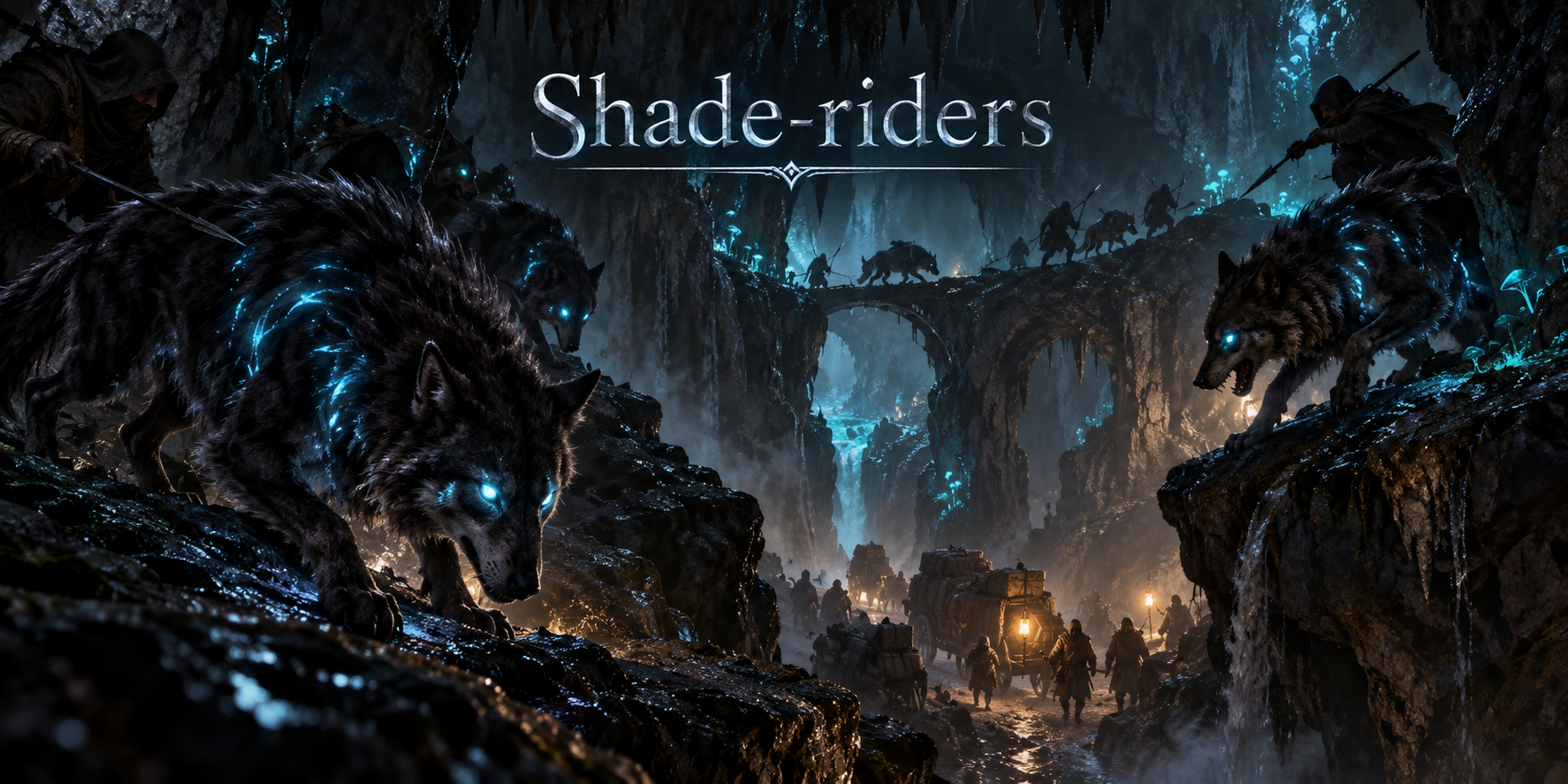
Raiders use side passages, echoes, darkness, and routes ordinary outfits avoid. Shade-riders keep half-wild dire wolves closer to their hunting instincts for intimidation and night attacks.
The giveaway is often the animals. Experienced Rangers can recognize an outlaw crew by how its wolves behave.
The surface is not empty adventure scenery. It is lethal cold, dry air, violent wind, blowing ice, unstable ruins, and retreat routes that may fail behind you.
The danger begins before open ice. Surface-connected passages can be frozen, drafty, unstable, poor in forage, and brutal on livestock.
Specialized crews face severe freezing temperatures, katabatic winds, blowing ice, long darkness, and hard glare when sunlight appears.
A field guide to Range talk
The useful words, working terms, place names, and animal language that keep the Deep Range from sounding like everybody swallowed a geology textbook in the dark.
A habitable cavern system with enough warmth, water, forage, and ecological productivity for livestock or settlement.
The maintained route network linking Stonewater, Fern Hollow, and Lantern Crossing. It is a web of paths, not one road.
Light produced by living organisms, including fungi, plants, invertebrates, and many Deep Range animals.
Biologically poor country where warmth, water, and forage are scarce, often separating productive basins.
A once-productive region whose supporting geothermal or chemical system failed or shifted.
The inhabited underground world of caverns, rivers, basins, settlements, grazing country, and drive trails.
The Three Bends settlement centered on agriculture, greenhouses, food, medicine, and livestock support.
A recurring ecological phase driven by heat, water, minerals, and microbial activity instead of surface weather.
The Three Bends trade and transit hub, known for markets, freight, couriers, caravans, and traveler services.
The mixed fungal turf, mineral moss, pale vegetation, roots, and microbial growth eaten by herbivores.
The primary large dairy livestock of the Deep Range. These massive, heavily furred, herd-oriented bison are raised chiefly for rich milk, with secondary roles in meat, hides, breeding, and limited draft work. Their horns and body markings glow softly, and their herds are especially important to Fern Hollow's food economy.
A period of increased biological productivity caused by favorable geothermal, groundwater, mineral, and microbial conditions.
The chemosynthetic foundation of life. Microbes feed the fungi, plants, insects, herbivores, and predators above them.
The heart of human civilization, containing the most productive basins, rivers, grazing country, and settlements.
A range-working unit made of people, livestock, working animals, equipment, routes, and often grazing rights.
The established saurian livestock species. Lambeosaurine refers to the broader animal category.
Country with enough reliable water, forage, heat, and ecological health to support herds and regular use.
The open working country between permanent settlements, including grazing chambers, trails, basins, and wild passages.
The person coordinating an outfit’s route, herd movement, timing, labor, and decisions in changing conditions.
A broad identity for riders, livestock handlers, scouts, range hands, guides, and specialists working open country.
Grazing country deliberately left unused long enough for living pasture and its Mineral Web to recover.
Aquatic working mount used for fishing, river work, wetland travel, and movement through flooded country.
An outlaw rider operating beyond legitimate range culture, often using half-wild dire wolves for raids and intimidation.
The industrial, water-powered Three Bends settlement built around mills, workshops, and heavy infrastructure.
The regional system formed by Stonewater, Fern Hollow, Lantern Crossing, and the Bendway between them.
The lethally cold surface above the Range, reached through rare and dangerous shafts and glacial passages.
A large predatory saurian used as a riding and working mount through trained partnership, never brute force alone.
The everyday Range name for Utahraptor, the powerful predatory riding mount used for active herd work, scouting, and rapid response.
The everyday Range name for Dilophosaurus, a light and alert riding mount valued for courier work, scouting, patrols, and fast travel.
The everyday Range name for Parasaurolophus, versatile herd livestock raised for hide, meat, breeding, and riding stock.
The established Range name for domesticated spinosaurid working mounts used for fishing, river work, wetland travel, and riding.
The shortened Range name for Cavern Crestback, a steady long-distance travel and pack mount bred for difficult regional routes.
The everyday Range name for Triceratops, the primary heavy draft animal used for freight, construction, and major loads.